
Many adults notice crowding, bite changes, or teeth that seem to shift over time. Others have lived with a smile concern for years and are finally ready to address it.
The short answer is yes. Adults can get braces if the teeth and supporting gums and bone are healthy enough for orthodontic movement, regardless of age.
Orthodontic treatment in adulthood can improve appearance, but it is not only cosmetic. It may also make crowded teeth easier to clean, reduce uneven wear, and improve how the upper and lower teeth meet.
Bryant Orthodontics provides adult orthodontics in Windsor Mill, MD, offering personalized care for adults considering braces or other alignment options.
A common reason adults ask about braces is that their teeth no longer look as straight as they once did. This can happen even if they had braces in the past.
Teeth may shift because of normal age-related changes, bite pressure, missing teeth, grinding, or relapse after earlier orthodontic treatment. Relapse means teeth gradually moving back toward their original position, especially when retainers are not worn as advised.
In some cases, shifting may also reflect gum or bone loss. That is why an orthodontic evaluation should look at the gums, jaw support, and overall dental health, not just visible alignment.
Adult orthodontic treatment can help with mild cosmetic concerns or more complex bite problems. The right plan depends on how the teeth fit together and whether the jaw relationship is part of the issue.
Braces or aligners may be used for crowding, spacing, rotated teeth, protruding front teeth, and bite patterns such as overbite, underbite, crossbite, or open bite. An overbite means the upper front teeth overlap the lower front teeth more than expected, while an underbite means the lower teeth sit in front of the upper teeth.
Some adults also seek treatment because food traps between crowded teeth, flossing is difficult, or certain teeth are wearing down faster than others. These are practical reasons to consider care, not vanity.
Not every bite problem can be corrected with braces alone. In more complex situations, treatment may involve restorative dentistry, periodontal care, tooth removal, or, in a smaller number of cases, jaw surgery.
Adults usually want treatment that works well and fits daily life. The best choice depends on the bite problem, appearance goals, work demands, and how consistently the appliance can be worn or maintained.
Metal braces remain one of the most effective options for many moderate to complex cases. Because they are fixed to the teeth, treatment does not depend on remembering to put them in.
Modern brackets are smaller and more comfortable than many people expect. They are visible, but they offer strong control and are often the most predictable choice for difficult bite correction.
Ceramic braces work like metal braces but use tooth-colored or clear brackets that blend in more. Many adults like them because they are less noticeable in photos and conversation.
They can be a good middle ground between appearance and control. They may be somewhat more delicate than metal brackets, and some cases still respond better to metal braces in selected areas.
Lingual braces are attached to the back surfaces of the teeth, so they are hidden from view. They can appeal to adults who want fixed treatment without visible brackets.
This option is not ideal for every case. It may affect speech more at first, can be harder to clean, and often requires a provider with specific experience.
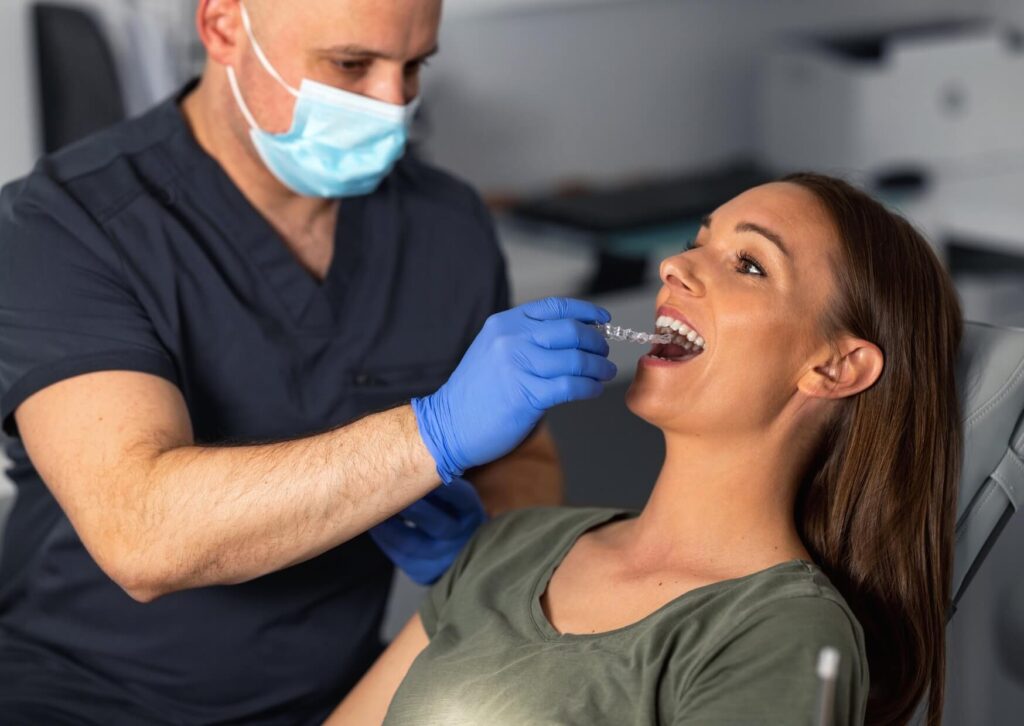
Clear aligners are removable trays that gradually shift teeth. Many adults prefer them because they are discreet and can be removed for meals, brushing, and special events.
They can be very effective in the right case, but they require consistent wear. If trays are not worn as directed, treatment may slow down or become less predictable, especially for more complex bite changes.
Adult teeth can move successfully, but adult treatment is not exactly the same as teen treatment. The supporting bone is fully developed, and adults are more likely to have crowns, fillings, implants, gum recession, or missing teeth that affect planning.
An implant, for example, does not move like a natural tooth. That can change how space is managed during treatment.
Adults may also have a history of clenching or grinding, called bruxism, which can affect tooth wear and bite stability. When gum inflammation or periodontal disease is present, periodontal treatment first is usually recommended before active orthodontic movement begins.
The best adult orthodontic plans often involve coordination between the orthodontist, general dentist, and sometimes a periodontist. That team approach can help support a healthier, more stable result.
One of the most common questions is how long treatment will take. There is no single timeline because simple alignment is very different from correcting a significant bite discrepancy.
Many adult cases take anywhere from several months to about two years, though some are shorter and some are longer. Treatment time depends on the starting position of the teeth, the health of the supporting tissues, the type of appliance used, and how closely instructions are followed.
Clear aligner treatment often depends heavily on wear consistency. Fixed braces remove that variable, but treatment can still slow if brackets break, appointments are delayed, or additional dental work is needed during the process.
After active treatment, retainers are essential. Without them, teeth may shift again over time, even after a well-finished result.
Most adults are relieved to learn that braces are usually more uncomfortable than painful. Soreness often happens after adjustments or when a new aligner tray is started, then settles as the teeth adapt.
Fixed braces can irritate the lips or cheeks early on. Using orthodontic wax can help.
Aligners may feel tight at first, but they usually do not rub the soft tissues as much. Speech changes are usually mild and temporary, though lingual braces and some aligner stages may be more noticeable at first.
Eating habits often need some adjustment with braces. Learn more about eating with braces.
Hard, sticky, or crunchy foods can damage brackets or wires, while aligners are removed for meals and drinks other than water. Cleaning also matters more during orthodontic treatment because plaque can collect around brackets, wires, and attachment points.
Healthy gums during braces are important because inflammation can make treatment less efficient and may increase the risk of staining or gum problems. Most adults adapt quickly once they settle into a routine.
Not every adult should start orthodontic treatment right away. If there is untreated decay, loose teeth, active gum disease, or significant jaw pain, those issues may need attention first.
A dental evaluation is especially important if teeth are shifting quickly, gums bleed easily, teeth feel mobile, or there is new spacing that was not there before. These changes can have several causes and should not be assumed to be a simple alignment issue.
Seek a prompt dental or orthodontic assessment if there is rapid tooth movement, loose teeth, swelling, or persistent pain. These symptoms may reflect gum disease, infection, trauma, bite overload, or another condition that needs diagnosis before braces are considered.
Jaw locking, difficulty opening, facial swelling, or pain after injury also deserve timely evaluation. Orthodontics may still be part of the long-term plan, but urgent problems come first.
For many adults, braces are worth it when treatment is tied to a clear goal. That goal may be a more even smile, easier cleaning, better bite function, or preparation for other dental work.
The tradeoffs are real. Treatment takes time, requires maintenance, and may involve visible appliances or daily tray wear.
Still, the long-term benefits can be meaningful. Straighter teeth may be easier to clean, bite forces may be distributed more evenly, and the result can support future dental work such as veneers, crowns, or implants when needed.
The most successful cases usually start with realistic expectations. Orthodontic treatment can improve a lot, but the best plan is the one that fits the biology of the teeth and gums, not just an ideal image.
It makes sense to schedule an evaluation if crowding is getting worse, teeth no longer meet comfortably, or previous orthodontic results have relapsed. It is also smart to ask about adult orthodontics before major restorative work if alignment could affect the final result.
A consultation usually includes an exam, photos, and often imaging to assess roots, bone levels, and bite relationships. That visit helps clarify whether braces, aligners, or another sequence of care makes the most sense.
If you have been putting off treatment because of age, that concern alone should not stop the conversation. A well-planned orthodontic evaluation can show what is possible, what needs to be addressed first, and what kind of result is realistic for your smile and bite.
At Bryant Orthodontics in Windsor Mill, MD, our adult orthodontics team helps patients from Owings Mills and Catonsville. Call us at (443) 917-2128 to schedule an evaluation.
Yes. Teeth can shift after earlier treatment, especially if retainers were not worn consistently or the bite changed over time. A new evaluation can show whether limited retreatment or full orthodontic care is the better option. For more on retreatment, see need braces again.
It depends on the case. Braces often offer stronger control for more complex tooth and bite movement, while aligners are popular for appearance and convenience when the case is suitable.
There is usually no strict age limit. The key issue is whether the teeth, gums, and bone support are healthy enough for safe movement.
They can, but not always. Treatment time depends more on case complexity, gum health, and treatment goals than on age alone.
Often yes, but planning matters. Crowns can usually be worked around, while implants do not move like natural teeth and may affect how the orthodontic plan is designed.